
The BV dimension: What Accommodation and Vergence Tell Us About Myopia Progression
May 25, 2026
By Dr. Eric Chow
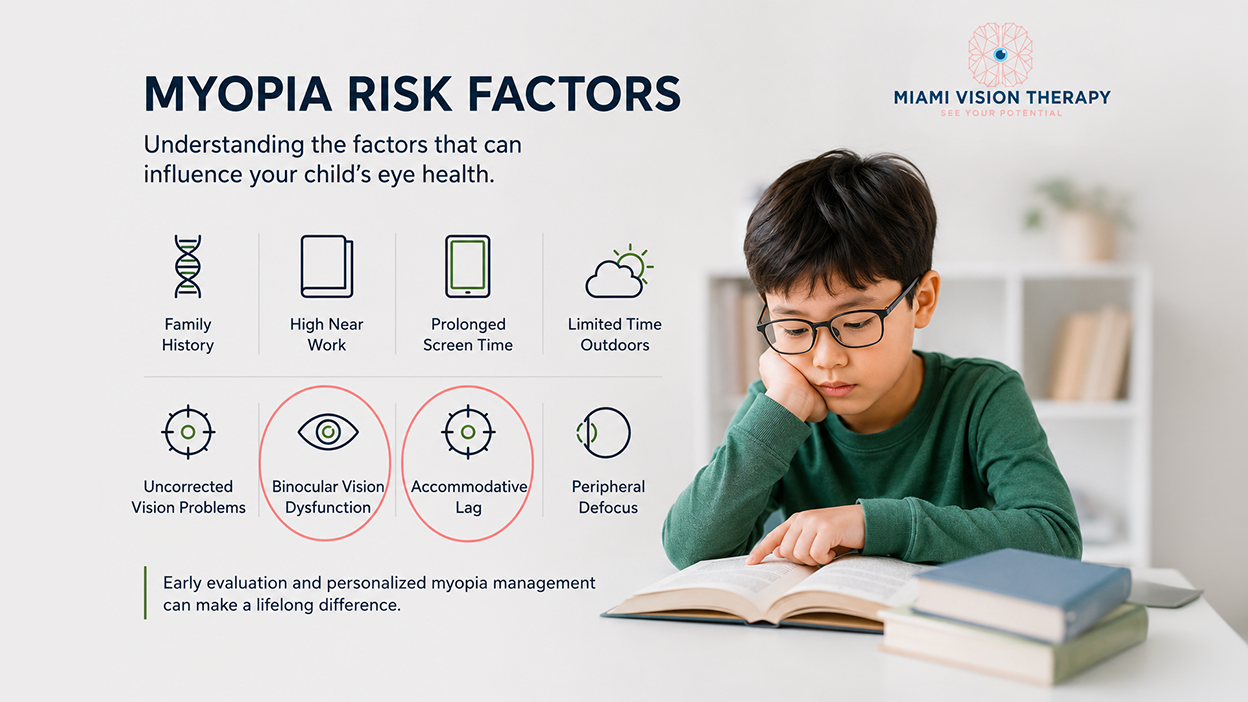
Myopia control has become one of the hottest topics in eye care. We are in the middle of a global epidemic, with projections suggesting that nearly half of the world's population will be myopic by 2050. As optometrists, we have developed (and are continuing to build) a solid framework for identifying children at greatest risk: we measure refractive error, track axial length, inquire about family history (one myopic parent doubles the risk; two myopic parents increases it fivefold), document age of onset, assess time spent outdoors, take note of near work habits, and ask about sleep. These are well-established, evidence-backed tools.
But there is a dimension of myopia assessment that often goes underutilized by most eyecare providers: the patient's accommodative and vergence status. How accurately does this child focus at near? How does their convergence system interact with their accommodation? Do they have an underlying binocular vision dysfunction that may be quietly driving their myopia?
I recently reviewed eight published peer-reviewed papers on this topic. What follows is a synthesis of the evidence and the clinical pearls I believe every eye care professional working in the myopia management space should carry into their exam room.
The Research: What the Literature Says
1. The IMI Sets the Stage — But Acknowledges the Complexity
Logan NS, et al. IMI Accommodation and Binocular Vision in Myopia Development and Progression. Invest Ophthalmol Vis Sci. 2021.
The International Myopia Institute (IMI) white paper on accommodation and binocular vision is the field's most authoritative overview, and its central message is one of honest complexity: the relationship between accommodative function, binocular vision, and myopia progression is real but not simple. The paper synthesizes decades of research and concludes that while accommodative lag and vergence anomalies are consistently associated with myopia, the direction of causality remains debated. One finding that stands out: elevated AC/A ratios, a marker of the coupling between accommodation and convergence, have been documented in myopic children compared to emmetropic children, and have been detected as early as four years before myopia onset. This white paper is essential reading not because it gives us clean answers, but because it appropriately frames what we do and don't know and makes the case that binocular vision assessment belongs in any myopia management workup.
Clinical Pearl #1: We should include AC/A ratio measurement in our myopia management workups.
2. The COMET Study: Your Patient's Binocular Vision Profile Changes the Myopia Risk Conversation
Gwiazda JE, et al. Accommodation and Related Risk Factors Associated with Myopia Progression and Their Interaction with Treatment in COMET Children. Invest Ophthalmol Vis Sci. 2004.
The original COMET study enrolled 469 ethnically diverse children ages 6–11 with myopia between −1.25 and −4.50 D, randomized to progressive addition lenses (PALs) with a +2.00 add or single vision lenses (SVLs). The overall PAL treatment effect was modest (about 0.20 D over three years). The researchers found that children with both larger accommodative lag and near esophoria when wearing single vision lenses showed the greatest myopia progression of any subgroup. Crucially, this same group also showed the greatest benefit from PAL treatment. The takeaway is not that PALs are a breakthrough intervention. The takeaway is that a child's binocular vision profile, specifically the combination of poor accommodative accuracy and near esophoria, identifies a higher-risk patient who will respond differently to treatment.
Clinical Pearl #2: Phoria testing and objective assessment of accommodative lag should be included in comprehensive myopia management evaluations.
3. COMET2 — Even a Targeted Intervention Is Modest, But the Subgroup Matters
COMET2 Study Group. Progressive-Addition Lenses Versus Single-Vision Lenses for Slowing Progression of Myopia in Children with High Accommodative Lag and Near Esophoria. Invest Ophthalmol Vis Sci. 2011.
COMET2 was designed specifically to test whether PALs could meaningfully slow progression in the high-lag, near-esophoria subgroup that COMET had identified. The trial enrolled 118 children ages 8 to 12 with low myopia and near esophoria of at least 2 prism diopters, all with high accommodative lag. Over three years, the PAL group progressed approximately 0.28 D less than the SVL group. This was statistically significant, but clinically modest. But before we give up on the concept of PALs or near add power, let’s take a deeper dive.
The COMET2 result deserves a closer read before we accept it at face value. We need to ask harder questions about how the study was actually executed. Were the children's eyes landing in the near zone during sustained reading? Was the frame sitting properly on each child's face throughout three years of follow-up? Was +2.00 D the right add for every child — or were some underdosed while others didn't need it at all? The add was never individualized to the patient's actual lag, which is a meaningful limitation in a study designed to target accommodative underresponse. And compliance tells its own story: PAL wearers reported wearing their lenses always or often only 72% of the time during school, 60% after school, and 60% on weekends — well below the SVL group at 90%, 76%, and 71% respectively.
Clinical Pearl #3: COMET2 did not prove that PALs don't work. It proved that a uniform optical intervention applied without individualization will always produce a diluted result. The real lesson here is clinical precision. Measure every child's accommodative lag individually. Assess near phoria at every myopia visit. If PALs are indicated, prescribe an add power matched to that child's actual lag. Not a blanket +2.00 D. Then execute the dispensing with the same rigor you bring to the prescription itself: choose a progressive design with a wide, accessible near zone and a short enough corridor that the child's eyes actually land in the near addition during reading. Verify the segment height. Adjust the frame at every follow-up visit. Counsel the family explicitly on compliance because in COMET2, PAL wearers were in their lenses only 60–72% of the time compared to 90% for single vision wearers, and that gap matters.
4. Myopes Focus Less Accurately — and It's Measurable
Kaphle D, et al. Accommodation Lags Are Higher in Myopia Than in Emmetropia: Measurement Methods and Metrics Matter. Ophthalmic Physiol Opt. 2022.
This carefully designed study compared accommodative lag in 24 emmetropes and 52 myopes using multiple instruments and metrics. The result was unambiguous: myopes had roughly double the accommodative lag of emmetropes, with mean values of 0.61 D versus 0.31 D respectively. Importantly, the paper also showed that measurement methodology matters enormously. Differences between instruments could be as large as 0.50 D, which may explain some of the conflicting findings in the literature. For clinicians, this study makes the case that accommodative lag in myopes is a robust, reproducible finding and that the choice of measurement tool affects what you see. If your clinic is measuring lag, standardizing your method is essential for tracking change over time.
Clinical Pearl #4: Myopic patients consistently demonstrate greater accommodative lag at near compared to emmetropic patients. Clinicians should choose a consistent method of evaluating accommodative lag — whether MEM retinoscopy, Nott retinoscopy, fused cross cylinder (FCC), or another standardized technique — and incorporate it into the myopia management evaluation.
5. The Counterpoint We Should Not Ignore — Lag May Be a Consequence, Not a Cause
Mutti DO, et al. Accommodative Lag Before and After the Onset of Myopia. Invest Ophthalmol Vis Sci. 2006.
This is arguably the most important counterpoint in the accommodative lag literature, drawn from the large CLEERE Study cohort of over 1,000 children followed longitudinally. The study tracked accommodative lag across years relative to the onset of myopia and found something striking: elevated lag did not precede myopia onset. Rather, it emerged after myopia became established. The authors concluded that increased hyperopic defocus from accommodative lag may be more of a consequence than a cause of myopia. This tells us that accommodative lag may tell us that a child's myopia is progressing, rather than explaining why it started.
Clinical Pearl #5: Elevated accommodative lag is a marker of progressing myopia, but it may not be the original driver. Use it for monitoring and treatment targeting, not solely for predicting who will become myopic.
6. Lag Alone Is an Incomplete Predictor — You Need the Full BV Picture
Berntsen DA, et al. Accommodative Lag and Juvenile-Onset Myopia Progression in Children Wearing Refractive Correction. Vision Res. 2011.
This large CLEERE Study analysis followed 592 myopic children wearing full refractive correction and asked a straightforward question: does a bigger accommodative lag mean faster myopia progression? Their answer was no. Lag measured on its own was not associated with how fast a child's myopia moved. On the surface, that sounds like a case against measuring accommodation at all. But that would be the wrong takeaway. One analogy is this: cholesterol alone does not predict a heart attack. But cholesterol combined with blood pressure, family history, and lifestyle absolutely does.
Accommodative lag works the same way. When the COMET studies looked at lag plus near esophoria together, that combined binocular vision profile identified both higher-risk progressors and greater PAL responders. Berntsen's study measured lag in isolation — and found exactly what you would expect when you look at one piece of a multi-part puzzle. The lesson is not that accommodation is irrelevant. The lesson is that a single measurement never tells the whole story. Assess the whole binocular vision system — lag, phoria, vergence ranges, AC/A ratio and interpret them together. That is where the clinical signal lives.
Clinical Pearl #6: Accommodative lag measured alone is like one lab value without the rest of the chart. It tells you something, but not enough. Always interpret lag in the context of the full binocular vision profile (especially near phoria).
7. The Accommodation-Vergence System in Progressing Myopes Is Fundamentally Different
Labhishetty V, Bobier WR. Are High Lags of Accommodation in Myopic Children Due to Motor Deficits? Vision Res. 2017.
This study asked a simple question: why do progressing myopes underaccommodate? Is the focusing system just mechanically weak? The answer turned out to be far more interesting. Progressing myopic children show a pattern that standard models of accommodation and vergence cannot actually explain — high accommodative lag occurring simultaneously with an elevated AC/A ratio and abnormally high accommodative adaptation. In plain terms: their focusing response is reduced, yet the convergence driven by that reduced focus is paradoxically elevated, and their system adapts to sustained near work in an atypical way. This combination should not co-exist according to our current understanding of how these two systems interact — yet in progressing myopes, it does. The authors propose that the underlying driver is reduced blur sensitivity: these children are simply less responsive to the signal that tells the focusing system to sharpen up.
Clinical Pearl #7: When you find high accommodative lag in a myopic child, do not stop there. Check the AC/A ratio. Check vergence behavior. These systems malfunction together in progressing myopes — not independently. Treating one without addressing the other is like fixing half the problem and wondering why the result is only half as good.
8. Vergence Dysfunction Can Undermine Your Best Myopia Control Tools
Ma J, et al. The Impact of Vergence Dysfunction on Myopia Control in Children Wearing DIMS Spectacle Lenses. Clin Ophthalmol. 2024.
This is the most directly actionable paper in this review, and the most modern. Researchers retrospectively reviewed myopic children who had been prescribed DIMS (Defocus Incorporated Multiple Segments) spectacle lenses and examined how different types of vergence dysfunction at baseline affected treatment outcomes. Children with convergence excess showed significantly faster axial length elongation than children with normal binocular vision, even while wearing the same validated myopia control lenses. The authors concluded that vergence dysfunction should be evaluated prior to adopting any myopia control strategy. It demonstrates that unaddressed vergence dysfunction does not just coexist with myopia — it can actively undermine the effectiveness of our best available interventions.
Clinical Pearl #8: Vergence dysfunction can challenge the effectiveness of validated myopia control devices. Screen for vergence dysfunction before prescribing myopia control, and treat it as part of the plan.
Putting It All Together: A Framework for Clinical Practice
What we can say with confidence:
● Accommodative lag is consistently higher in myopes than emmetropes, roughly double on average.
● The combination of high accommodative lag and near esophoria identifies a higher-risk subgroup that also responds differently to optical treatment.
● Vergence dysfunction, particularly convergence excess, can reduce the effectiveness of a validated myopia control intervention (specifically the DIMS spectacle lens)
● The accommodation and vergence systems are co-dysregulated in progressing myopes, not independent.
What remains genuinely uncertain:
● Whether elevated lag causes faster progression, or primarily reflects it.
● Whether correcting lag is sufficient on its own to meaningfully slow axial elongation.
● The optimal treatment sequence when BV dysfunction and myopia co-occur.
Every child presenting for myopia management should have a complete binocular vision workup, not just refraction and axial length, but at least accommodative lag, near and distance phoria, vergence ranges, and AC/A ratio assessment. This information should help guide both patient evaluation and treatment decisions.
If accommodative or vergence dysfunction is identified, it should be addressed as part of the overall myopia management strategy rather than treated as a secondary issue. This may include vision therapy, prism, lens additions, or other individualized interventions based on the patient’s binocular vision findings. From a vision therapy perspective, much of the treatment process involves improving a child’s ability to focus accurately, sustain accommodation, and spatially align the eyes efficiently during visual tasks. Research has shown that accommodative amplitudes, vergence ranges, and binocular coordination can be trained and improved. In addition, response to myopia control treatment should be monitored over time with the understanding that binocular vision status may change as the child grows, visual demands evolve, and the optical environment changes.
Final Thoughts
Here is my clinical bottom line: I invite you all to just look. Add five minutes to your exam and check accommodation and vergence in every myopic child you see. Measure near phoria. Introduce a +1.00 lens and remeasure — the difference is your AC/A ratio. Run MEM retinoscopy to quantify accommodative lag. Five minutes. That is all it costs, and what it buys you is a fundamentally richer understanding of that child's visual system.
Because we cannot keep practicing myopia management as though every child is the same. A blanket +2.00 add on every progressing myope is not a strategy — it is a habit. No single myopia control option is universally best. The right choice depends on the individual: their binocular vision profile, their age, their rate of progression, their lifestyle, their family's financial situation, and their cultural context. A child who cannot access soft contact lens-based myopia control still deserves a precisely individualized optical approach — and that requires us to know their lag, know their phoria, and prescribe accordingly.
Stay curious about the intersection of binocularity and myopia management — because the questions we are just beginning to ask are the ones that will define how we practice next. How does orthokeratology shift vergence posture? How does low-dose atropine affect accommodative function? How do dual focus soft contact lenses interact with a child's existing binocular vision profile? I explored these questions in a piece I wrote for Review of Myopia Management, where I looked specifically at how low-dose atropine, orthokeratology, and dual focus soft contact lenses each affect binocular vision measurements — and proposed a framework for using those measurements to guide which treatment option is the best fit for an individual child. If this topic interests you, I invite you to give it a read. https://reviewofmm.com/the-importance-of-binocular-vision-in-managing-myopia-progression/
The research in this space is complex, sometimes contradictory, and still unfolding. But the signal is clear enough to act on today: binocular vision assessment belongs in every myopia management exam — not as an afterthought, but as a foundation. The child's binocular vision status is part of the myopia story. It is time we read it that way.
References
- Logan NS, Radhakrishnan H, Cruickshank FE, Allen PM, Bandela PK, Davies LN, Hasebe S, Khanal S, Schmid KL, Vera-Diaz FA, Wolffsohn JS. IMI Accommodation and Binocular Vision in Myopia Development and Progression. Invest Ophthalmol Vis Sci. 2021;62(5):4. doi:10.1167/iovs.62.5.4
- Gwiazda JE, Hyman L, Norton TT, Hussein MEM, Marsh-Tootle W, Manny R, Wang Y, Everett D; COMET Group. Accommodation and Related Risk Factors Associated with Myopia Progression and Their Interaction with Treatment in COMET Children. Invest Ophthalmol Vis Sci. 2004;45(7):2143–2151. doi:10.1167/iovs.03-1306
- COMET2 Study Group. Progressive-Addition Lenses Versus Single-Vision Lenses for Slowing Progression of Myopia in Children with High Accommodative Lag and Near Esophoria. Invest Ophthalmol Vis Sci. 2011;52(5):2749–2757. doi:10.1167/iovs.10-6631
- Kaphle D, Varnas SR, Schmid KL, Suheimat M, Leube A, Atchison DA. Accommodation Lags Are Higher in Myopia Than in Emmetropia: Measurement Methods and Metrics Matter. Ophthalmic Physiol Opt. 2022;42(5):1103–1114. doi:10.1111/opo.13021
- Mutti DO, Mitchell GL, Hayes JR, Jones LA, Moeschberger ML, Cotter SA, Kleinstein RN, Manny RE, Twelker JD, Zadnik K; CLEERE Study Group. Accommodative Lag Before and After the Onset of Myopia. Invest Ophthalmol Vis Sci. 2006;47(3):837–846. doi:10.1167/iovs.05-0888
- Berntsen DA, Sinnott LT, Mutti DO, Zadnik K; CLEERE Study Group. Accommodative Lag and Juvenile-Onset Myopia Progression in Children Wearing Refractive Correction. Vision Res. 2011;51(9):1039–1046. doi:10.1016/j.visres.2011.02.016
- Labhishetty V, Bobier WR. Are High Lags of Accommodation in Myopic Children Due to Motor Deficits? Vision Res. 2017;130:9–21. doi:10.1016/j.visres.2016.11.001
- Ma J, Li Y, Zhang X, et al. The Impact of Vergence Dysfunction on Myopia Control in Children Wearing Defocus Incorporated Multiple Segments Spectacle Lenses. Clin Ophthalmol. 2024;18:799–807. doi:10.2147/OPTH.S453731

All Vision Therapy Services
Discover personalized eye care excellence with our comprehensive vision therapy services. Our expert team treats a wide range of vision conditions, including amblyopia (lazy eye), strabismus (eye misalignment), binocular vision disorders, double vision, post-concussion vision syndrome, and more.

Keep In Touch
For non-urgent questions or to learn more about our services, contact us today!
© 2026 Miami Vision Therapy. All rights Reserved -
Accessibility Statement
-
Privacy Policy
-
Sitemap
Managed and Designed by 