
Vision Screening vs. Eye Exam: Why "Passing" Isn't the Whole Story — and Why I Created SANDS™
November 2026
Dr. Eric Chow
Vision Screening vs. Eye Exam: Why "Passing" Isn't the Whole Story — and Why I Created SANDS™
A Miami eye doctor on what school vision screenings miss, and the stronger screening I built to catch it
By Dr. Eric Chow, OD, FAAO, FOVDR · Miami Vision Therapy · November 2026
The short answer: A vision screening is a quick check, usually of whether your child can read a chart across the room. A comprehensive eye exam is a full evaluation by an eye doctor of how clearly the eyes see, how well they work together, and how healthy they are. A child can pass a screening and still have a vision problem that makes reading and learning harder.
"But she passed her vision screening."
I hear that sentence in my office in Pinecrest almost every week. A parent sits across from me, confused and a little frustrated. Their child reads slowly, skips lines, rubs their eyes, gets headaches after homework or avoids books altogether. The school screening came back fine. So how could it be their eyes?
Here's the honest answer: Those children usually would pass a traditional vision screening. But when I examine them, it's often obvious they have a binocular vision disorder. That pattern, child after child, family after family, convinced me that the traditional vision screening is not enough. We need a stronger one.
That's why I created the SANDS™ Protocol. But first, let's clear up one of the most misunderstood topics in children's health.
What is a vision screening?
A vision screening is a quick check, done at school, at the pediatrician's office or at a community event. Its job is to flag children who might have a problem and need a closer look.
Most screenings focus on one question: Can your child read letters on a chart across the room? That's distance visual acuity, the "20/20" number most people know.
In Florida, schools are required to provide vision screening in kindergarten, 1st, 3rd and 6th grade, plus for students new to Florida schools in kindergarten through 5th grade.¹ That's a valuable safety net, and it catches many children who need glasses to see the board.
But a screening is not a diagnosis. It was never meant to replace an exam. The American Academy of Optometry says it plainly: "Vision screenings… do not replace comprehensive eye examinations."²
What is a comprehensive eye exam?
A comprehensive eye exam is performed by an eye doctor. It takes longer and goes much deeper. At Miami Vision Therapy, Dr. Adriana Benitez and I look at:
- Clarity at distance and up close, and an accurate prescription if needed
- Eye teaming: how well the two eyes work together as a pair
- Focusing: how easily the eyes adjust and hold focus on near work like reading
- Eye movements: how accurately the eyes track across a line of text
- Eye health: the inside and outside of the eye, including the retina and optic nerve
The main point: A screening asks, "Can you see the chart?" An eye exam asks, "How well do your eyes see, work together and stay healthy?"
Why children "pass" and still struggle
A child can see 20/20 on a distance chart and still have a binocular vision disorder, a problem with how the eyes team, focus or move together.
These problems show up at near, during reading and homework, not when looking at a chart 20 feet away. The ones I see most often:
- Convergence insufficiency: the eyes struggle to turn inward and stay aligned for close work
- Focusing (accommodative) problems: focus fades or blurs during reading
- Eye movement (tracking) problems: losing place, skipping words or lines
- Small eye misalignments, including vertical ones, that cause headaches, fatigue or double vision
These are more common than most parents realize. One study of school-age children found about 2% had definite convergence insufficiency, while roughly 14% showed at least one sign of it. Published estimates range from about 2% to over 30%, depending on how it's measured.³
And children rarely complain. They don't know vision is supposed to feel any different. So instead, the struggle looks like slow reading, poor attention, avoiding homework or "just not trying." I've seen it mistaken for a learning or attention problem more times than I can count.
Why I created the SANDS™ Protocol
I created SANDS™ in December 2024 to close that gap.
SANDS™ is a functional vision screening. Like a traditional screening, it's quick: under 8 minutes per child. But instead of stopping at "can you read the chart," it also checks the visual skills that matter most for reading and learning.
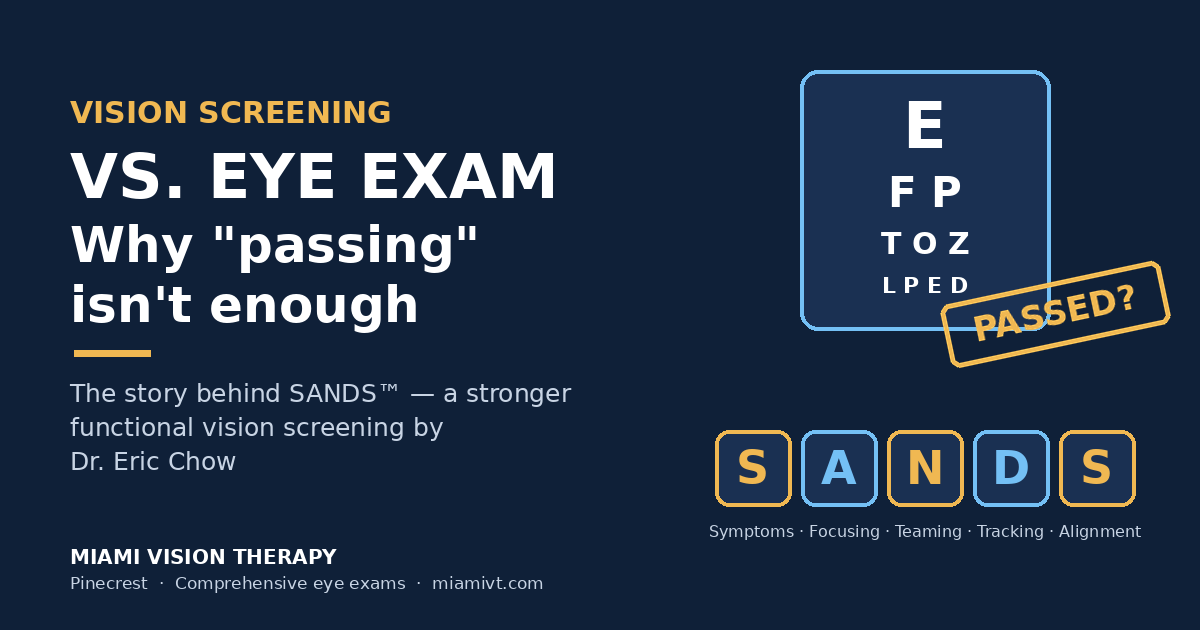
SANDS™ stands for its five parts:
- S — Symptoms: a short checklist of the complaints and behaviors that often signal a problem, like headaches, losing place or words moving on the page
- A — Accommodation: how well the eyes focus up close
- N — Near point of convergence: how well the eyes team together as something moves closer
- D — Digit naming: a timed number-reading task that shows how efficiently the eyes move across a line, like reading text
- S — Sofa test: a simple check of how well the two eyes are aligned, including small vertical misalignments that standard screenings often miss
A child who has trouble with two or more parts is referred to a developmental or functional optometrist for a full evaluation. SANDS™ doesn't diagnose. It finds the children who need a closer look, sooner.
Schools and occupational therapists are already using SANDS™, and it's helping them identify binocular vision disorders and get children help earlier.
My dream is for SANDS™ to become part of Florida's school vision screenings. Those screening grades are the perfect moments to catch these problems, before a child falls behind or decides they're just "not a reader."
Who can give the SANDS™ screening?
Anyone can administer SANDS™ after a short, required training. I train professionals myself, and I provide the SANDS™ kit for free.
If you are a school nurse, occupational therapist, pediatrician, teacher or other professional who works with children, I'd love to hear from you. Email info@miamivt.com to request your free SANDS™ kit and training. You can also visit our professional referrals page.
Key takeaways
1. A screening is not an exam. Passing a vision screening means your child can likely see the chart. It doesn't mean their eyes work well together for reading.
2. Many vision problems hide at near. Eye teaming, focusing and tracking problems often go undetected by distance-only screenings.
3. Watch for the signs. Headaches, skipping lines, slow reading, rubbing eyes, covering one eye or avoiding homework are worth an exam.
4. SANDS™ raises the bar for screenings. It's an under-8-minute functional screening that checks the skills that matter for learning.
5. When in doubt, book an exam. A comprehensive eye exam is the only way to know for sure.
Frequently asked questions
What is the difference between a vision screening and an eye exam? A vision screening is a quick check, usually of distance vision, that flags children who might need help. A comprehensive eye exam is performed by an eye doctor and evaluates clarity at all distances, eye teaming, focusing, eye movements and eye health. A screening can suggest a problem; only an exam can diagnose and treat it.
My child passed the school vision screening. Do they still need an eye exam? Yes. Passing a screening is good news, but many vision problems, especially those affecting reading and near work, can be missed. The American Optometric Association recommends a comprehensive eye exam before first grade and every year for school-age children.⁴
What grades get vision screenings in Florida schools? Florida requires vision screening in kindergarten, 1st, 3rd and 6th grade, and for students new to Florida schools in kindergarten through 5th grade.¹
What is the SANDS™ Protocol? SANDS™ is a functional vision screening created by Dr. Eric Chow, OD, of Miami Vision Therapy. In under 8 minutes, it checks Symptoms, Accommodation (focusing), Near point of convergence (eye teaming), Digit naming (eye movements) and a Sofa test (eye alignment). Children who have difficulty on two or more parts are referred for a full functional vision evaluation.
Can a school nurse or occupational therapist use SANDS™? Yes. Anyone can administer SANDS™ after a short, required training from Dr. Chow. The SANDS™ kit is free. Email info@miamivt.com to request one.
What are signs of a binocular vision problem in children? Common signs include headaches with reading, skipping words or lines, losing place, slow or tiring reading, rubbing the eyes, closing or covering one eye, double vision, poor attention during homework and avoiding near work.
Who is a good pediatric eye doctor in Miami for binocular vision problems? Dr. Eric Chow, OD, FAAO, FOVDR, is a developmental and functional optometrist at Miami Vision Therapy in Pinecrest who specializes in binocular vision disorders, vision therapy and concussion-related vision problems. Dr. Adriana Benitez, OD, provides comprehensive eye exams for children, teens and adults in English and Spanish.
Where is Miami Vision Therapy located? 9655 S. Dixie Hwy, Suite 202, in Pinecrest, convenient to South Miami, Kendall, Palmetto Bay and Coral Gables.
Did your child pass a vision screening but still struggle with reading or homework? Don't wait for the next screening. Schedule a comprehensive eye exam with Dr. Adriana Benitez and me at Miami Vision Therapy.
Book an Eye Exam →
Or call (786) 558-7295, or email info@miamivt.com with any questions. Learn more about our examination types, vision therapy, and our doctors.
About the author: Dr. Eric Chow, OD, FAAO, FOVDR, is a developmental and functional optometrist and the owner and clinical director of Miami Vision Therapy in Pinecrest. He is the creator of the SANDS™ Protocol and specializes in pediatric binocular vision disorders, vision therapy and neuro-optometric rehabilitation for concussion and brain injury. He practices alongside Dr. Adriana Benitez, OD, a Miami-raised, bilingual (English/Spanish) optometrist who provides comprehensive eye exams for children, teens and adults. Together they offer full-scope family eye care plus specialty vision care at 9655 S. Dixie Hwy, Suite 202, Miami, FL 33156.
This article is for general education and is not medical advice. SANDS™ is a screening tool and does not diagnose vision conditions.

References
- Florida Administrative Code. Rule 64F-6.003, Screening. Accessed October 27, 2026. law.cornell.edu/regulations/florida/Fla-Admin-Code-Ann-R-64F-6-003
- American Academy of Optometry. Childhood Vision Screening [policy statement]. Updated August 11, 2016. aaopt.org/position-paper
- Nunes AF, Monteiro PML, Ferreira FBP, Nunes AS. Convergence insufficiency and accommodative insufficiency in children. BMC Ophthalmol. 2019;19:58. doi.org/10.1186/s12886-019-1061-x
- American Optometric Association. Comprehensive eye exams: recommended examination frequency. aoa.org/healthy-eyes/caring-for-your-eyes/eye-exams
Quick Links

All Vision Therapy Services
Discover personalized eye care excellence with our comprehensive vision therapy services. Our expert team treats a wide range of vision conditions, including amblyopia (lazy eye), strabismus (eye misalignment), binocular vision disorders, double vision, post-concussion vision syndrome, and more.

Keep In Touch
For non-urgent questions or to learn more about our services, contact us today!
© 2026 Miami Vision Therapy. All rights Reserved -
Accessibility Statement
-
Privacy Policy
-
Sitemap
Managed and Designed by 