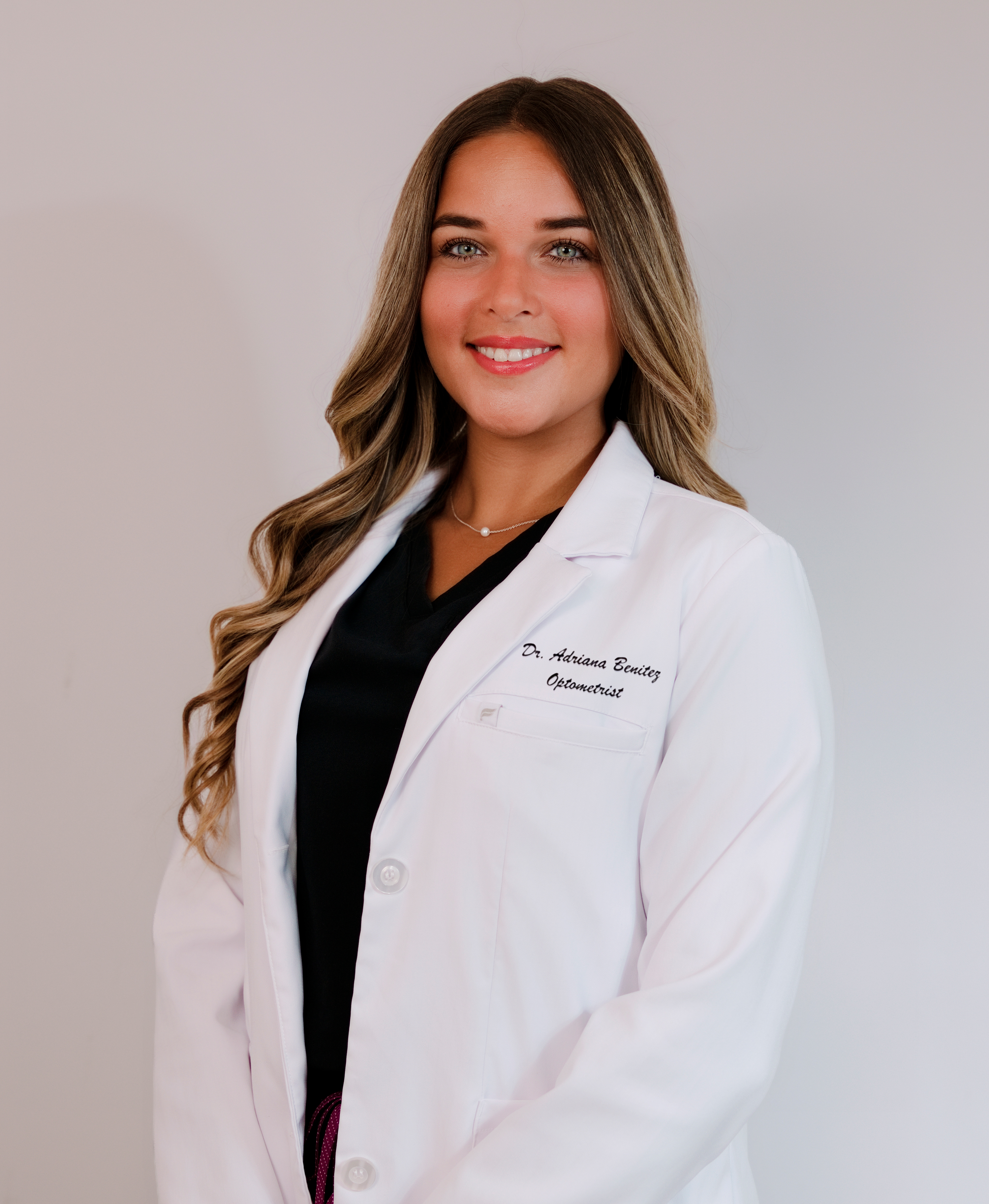
Meet Dr. Adriana Benitez: The Miami-Raised, Spanish-Speaking Eye Doctor Who Takes Time to Listen
October 2026
Dr. Eric Chow, OD
A comprehensive eye exam in Pinecrest that starts with your story and goes well beyond "Do I need glasses?"
MIAMI — Some patients arrive at the eye doctor having already been told it's "just dry eye," or that their vision is "fine." If you're looking for a Spanish-speaking eye doctor in Miami who will slow down and ask what's really going on, meet Dr. Adriana Benitez. She now provides comprehensive eye exams for children, teens and adults at Miami Vision Therapy in Pinecrest.
Dr. Benitez grew up right here in Miami. She sees patients in English and in Spanish, and she believes the most useful part of an eye exam often comes before any testing: listening.
"I like to start by really listening to why the patient is there," she says, "and asking about how their vision affects their day-to-day life, rather than immediately jumping into testing."
The main point: A comprehensive eye exam with Dr. Benitez checks how clearly you see and how healthy your eyes are. It also checks how well your eyes work together. That last part is what many quick exams leave out.
A Miami story: the first doctor in the family
Dr. Benitez earned her Doctor of Optometry degree at Nova Southeastern University College of Optometry in Fort Lauderdale. Choosing medicine was personal for her.
"My parents are immigrants, and growing up I always wanted to become the first doctor in my family and make them proud," she says. "When I started exploring different paths in healthcare, optometry just felt like the most 'me' version of being a doctor."
She liked that optometry combines medicine with problem-solving. She also liked that it lets her build long-term relationships with patients. "Vision affects so many parts of everyday life," she adds, "from school and work to sports, reading, driving and overall quality of life."
For the many Miami families who are most comfortable in Spanish, being able to talk with your doctor directly makes a real difference. Patients can describe their symptoms in their own words, and their family can follow exactly what was found.
What a comprehensive eye exam with Dr. Benitez looks like
Every exam starts with a conversation. Dr. Benitez asks how you use your eyes: reading, computer work, school, sports, driving, contact lenses. She also asks about headaches or fatigue at the end of the day.
"Sometimes those details are what point us toward the real issue," she explains.
From there, the exam covers four areas:
- Visual acuity and prescription: how clearly you see at distance and near, and whether glasses or contact lenses would help.
- Eye teaming: how well your two eyes aim and work together as a pair.
- Focusing and eye movements: how easily your eyes shift focus and track across a page or screen.
- Eye health: a careful look at the front and back of the eye for conditions such as glaucoma and diabetic retinopathy, which often cause no symptoms early on.
"One thing patients may not expect is how much we can learn beyond whether they need glasses," Dr. Benitez says. "Someone can see 20/20 and still have difficulties with eye teaming, focusing or tracking, or have other eye conditions such as glaucoma or diabetic retinopathy."
Why the extra time matters
An exam with Dr. Benitez usually takes one to one and a half hours, depending on the patient and the type of visit. That's time to listen, run the tests that make sense for you, and explain what she found without rushing. If a question comes up later, she offers a follow-up video consult to go over the diagnosis and next steps.
She is careful not to criticize other offices. "I wouldn't necessarily say that a shorter exam is a bad exam," she says. "But when time is very limited, there may be less opportunity to explore symptoms that don't fit neatly into 'Do I need glasses?'"
At Miami Vision Therapy, the length of your exam depends on what you need, not on a vision or medical plan's schedule.
The patient who stayed with her
During her fourth year of optometry school, Dr. Benitez saw an older gentleman whose eyes were red, swollen, watery and sore. He had seen several doctors. Most had told him it was dry eye and to keep using lubricating drops.
He spoke only Spanish. When Dr. Benitez went through his history with him in his own language, the pieces came together. His symptoms were a reaction to the preservatives in one of his glaucoma eye drops.
That's a well-documented problem. Many glaucoma drops contain a preservative called benzalkonium chloride (BAK). With long-term use, BAK can irritate and inflame the surface of the eye, and the result can look a lot like ordinary dry eye.¹
"He really stuck with me because he was such a sweet, patient person, and his family was so worried about him," she remembers. "At one point there were about five family members in the exam room, all just wanting him to feel better. I felt an extra connection being able to communicate with him directly and help his family understand what was going on."
"That experience reminded me how much good patient care comes down to simply listening, asking the right questions, and taking the time to really get to know the person in front of you."
What she sees most in Miami
Screen strain and dry eye. Long hours on phones and computers, plus air conditioning running all year, add up to dry, tired, irritated eyes for many people in South Florida.
Nearsightedness in children. Dr. Benitez pays close attention to rising rates of myopia (nearsightedness) in kids. Researchers project that about half of the world's population could be nearsighted by 2050.² More near work and screen time, along with less time outdoors, play a role. Studies link more outdoor time in childhood with a lower risk of developing myopia.³ So she talks with families about healthy visual habits and getting kids outside.
She is especially interested in myopia management, orthokeratology (Ortho-K) and specialty contact lenses. These approaches aim to slow how fast a child's nearsightedness gets worse, not just correct it with stronger glasses each year. Learn more on our myopia management page.
Who she loves caring for
Dr. Benitez sees a mix of children, teens and adults. She especially enjoys working with young adults and contact lens wearers. Outside the office, she spends time with her family and travels with her husband.
Here is how she sums up her approach:
"I try to take the time to understand what my patients are actually experiencing rather than focusing only on numbers or test results. I want patients to feel comfortable asking questions and to leave understanding what we found, why it matters and what their options are."
Key takeaways
1. An eye exam is more than a glasses check. A comprehensive exam with Dr. Benitez looks at clarity, eye teaming, focusing, eye movements and eye health.
2. 20/20 isn't the whole story. You can see 20/20 and still have trouble with how your eyes work together, or have an eye disease that hasn't caused symptoms yet.
3. Your history matters. Taking time to listen can uncover the real cause of symptoms, like a reaction to preservatives in eye drops that had been treated as dry eye.
4. Care in your language. Dr. Benitez sees patients in both Spanish and English.
5. Watch for myopia in kids. Screen time and too little time outdoors are linked to rising nearsightedness, and options exist to help slow it.
Frequently asked questions
Does Dr. Benitez speak Spanish? Yes. Dr. Adriana Benitez sees patients in Spanish and English at Miami Vision Therapy in Pinecrest. Sí, la Dra. Benitez atiende a sus pacientes en español.
What is included in a comprehensive eye exam? A full case history, visual acuity and prescription testing, and evaluation of eye teaming, focusing and eye movements. It also includes a careful eye health exam that checks for conditions such as glaucoma and diabetic retinopathy.
How long does an eye exam at Miami Vision Therapy take? Typically one to one and a half hours, depending on the patient and the visit. Follow-up video consults are available if you have more questions.
How often should my child and I get an eye exam? For many patients, once a year is a good starting point. The American Optometric Association recommends an exam before first grade and every year after that for school-age children. It recommends exams at least every two years for low-risk adults ages 18 to 64, and every year from age 65.⁴ Dr. Benitez adjusts this based on your eye health, medical and family history, contact lens wear and symptoms.
Does Miami Vision Therapy only do vision therapy? No. Despite our name, we offer comprehensive eye exams for the whole family, along with specialty care such as vision therapy, myopia management and neuro-optometric rehabilitation.
Where is Miami Vision Therapy located? 9655 S. Dixie Hwy, Suite 202, in Pinecrest. We're convenient to South Miami, Kendall, Palmetto Bay and Coral Gables.
Ready for an eye exam that takes the time to listen? Schedule a comprehensive eye exam with Dr. Adriana Benitez and Dr. Eric Chow at Miami Vision Therapy.
Or call (786) 558-7295. Meet the rest of our doctors on our team page, or read about vision therapy and our examination types.
About the doctors: Dr. Adriana Benitez, OD, is a Miami-raised, bilingual (English/Spanish) optometrist and a graduate of Nova Southeastern University College of Optometry. She provides comprehensive eye exams for children, teens and adults at Miami Vision Therapy, with a special interest in contact lenses and myopia management. Dr. Eric Chow, OD, FAAO, FOVDR, is a functional optometrist and the owner of Miami Vision Therapy. Together they offer full-scope eye care plus specialty vision care in Pinecrest.
This article is for general education and is not medical advice. Patient details have been kept general to protect privacy.
References
- Goldstein MH, Silva FQ, Blender N, Tran T, Vantipalli S. Ocular benzalkonium chloride exposure: problems and solutions. Eye (Lond). 2022;36(2):361-368. pubmed.ncbi.nlm.nih.gov/34262161
- Holden BA, Fricke TR, Wilson DA, et al. Global prevalence of myopia and high myopia and temporal trends from 2000 through 2050. Ophthalmology. 2016;123(5):1036-1042. sciencedaily.com summary
- American Academy of Ophthalmology. Time outside may reduce myopia risk in children. aao.org
- American Optometric Association. Comprehensive eye exams: recommended examination frequency. aoa.org
Quick Links

All Vision Therapy Services
Discover personalized eye care excellence with our comprehensive vision therapy services. Our expert team treats a wide range of vision conditions, including amblyopia (lazy eye), strabismus (eye misalignment), binocular vision disorders, double vision, post-concussion vision syndrome, and more.

Keep In Touch
For non-urgent questions or to learn more about our services, contact us today!
© 2026 Miami Vision Therapy. All rights Reserved -
Accessibility Statement
-
Privacy Policy
-
Sitemap
Managed and Designed by 