
My Child Has 20/20 Vision But Still Struggles: 7 Questions to Ask at Their Next Eye Exam
June 24, 2026
Dr. Eric Chow, OD
If your child passed every eye exam but still can't read without headaches, loses their place, or gets labeled "inattentive" — the problem may be hiding in plain sight
MIAMI — The call comes from the school counselor. Your child is smart, clearly bright, but struggling to keep up. Homework takes three times longer than it should. They avoid reading, complain of headaches by afternoon, and get distracted the moment they open a book. You take them to the eye doctor — and they pass with flying colors. 20/20. No glasses needed. "Vision is fine," the doctor says.
So why is your child still struggling?
The main point: A standard eye exam focuses on one thing — whether your child can read letters on a chart 20 feet away. It tells you almost nothing about how their eyes perform the complex, sustained near work that reading and learning demand. For millions of children, a "perfect" eye exam result is the beginning of years of frustration — not the end of their vision story.
"I see this all the time," says Dr. Eric Chow, OD, a functional optometrist and vision therapy specialist at Miami Vision Therapy. "A child has been struggling for years. Parents have been told there's nothing wrong with their eyes. But when we actually run a functional evaluation — testing how the eyes work together, track, and focus — we find real, treatable problems that a standard exam was never designed to find."
The 20/20 Myth: What That Number Actually Means
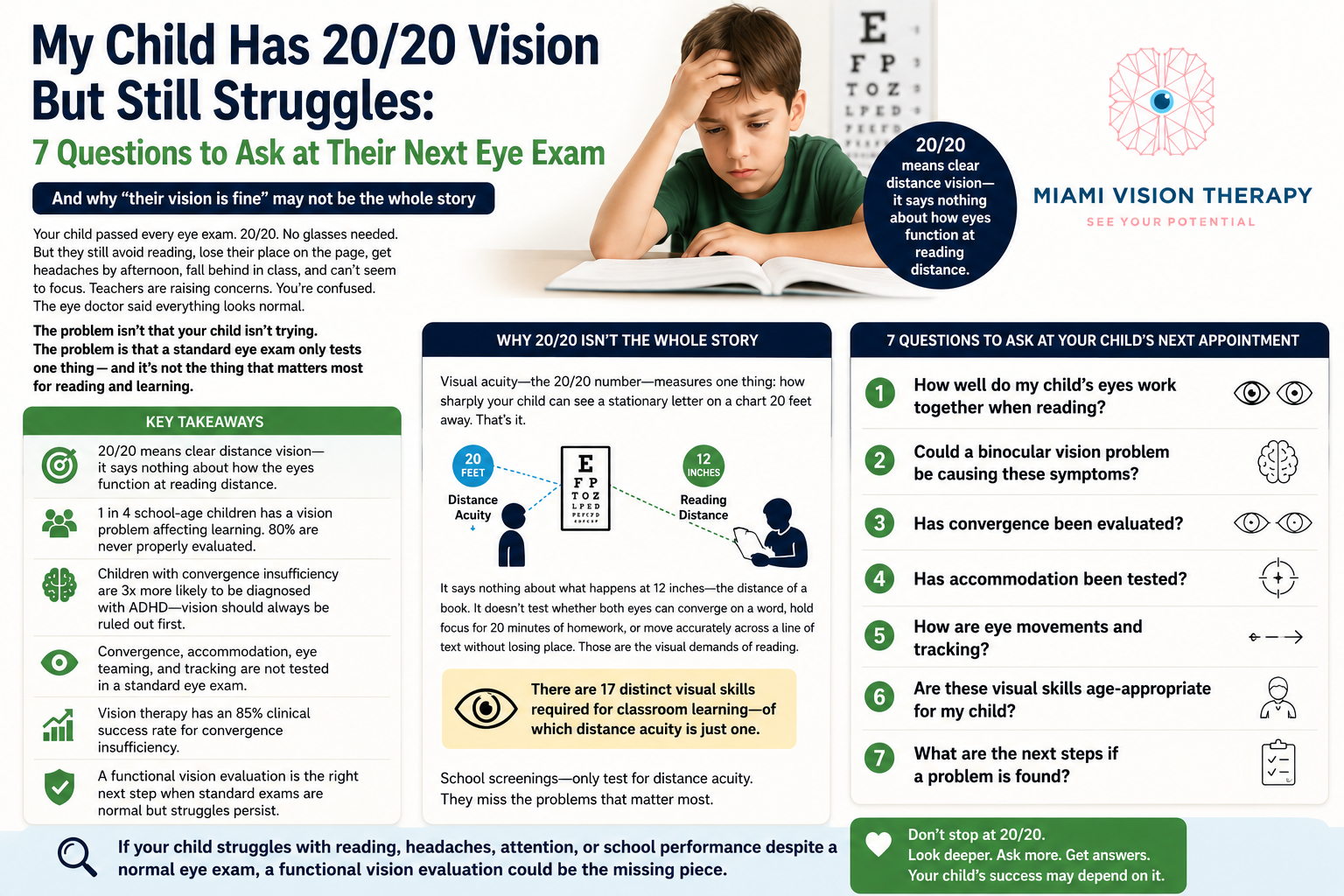
Visual acuity — the 20/20 measurement — measures one thing: how sharply your child can see a stationary letter on a chart 20 feet away. That's it. It says nothing about what happens at 12 inches — the distance of a book. It doesn't test whether both eyes can converge on a close target, hold focus for 20 minutes, or move smoothly across a line of text without losing place.
These are the skills that reading actually requires. And there are 17 distinct visual skills that matter for learning — of which visual acuity is just one.
The College of Optometrists in Vision Development (COVD) estimates that 1 in 4 school-age children has a vision problem that affects their learning. The National PTA reports that over 10 million children in the U.S. are affected by vision problems that impact school success. And critically: 80% of those children will never receive a comprehensive functional vision evaluation.
School screenings — the ones where a nurse hands your child an eye chart — only test for distance acuity. They miss the problems that matter most for learning.
Could It Be Vision — Not ADHD?
Here's the finding that stops parents cold: children with convergence insufficiency (CI) are three times more likely to be diagnosed with ADHD than children without it.
The symptoms overlap almost perfectly. A child whose eyes can't sustain close focus will squirm, disengage, avoid reading, and appear inattentive — not because they lack attention, but because their visual system is exhausted. The brain, working overtime to fuse misaligned images from two poorly-coordinating eyes, runs out of capacity. It looks like distraction. It looks like behavior. It looks like ADHD.
"Before we accept that a child has a purely attentional problem, we owe it to them to rule out a visual cause," says Dr. Chow. "Convergence insufficiency is highly treatable. Vision therapy has an 85% clinical success rate for CI."
This is not to say ADHD doesn't exist — it absolutely does, and can coexist with vision problems. But ruling out a visual cause first is a critical, often skipped step.
7 Questions to Ask at Your Child's Next Eye Exam
If your child struggles with reading, headaches, attention, or school performance despite passing their eye exam, bring these questions to their next appointment. If your eye care provider can't answer them, ask for a referral to a developmental/functional optometrist, someone who specialized in vision therapy — a specialist trained in functional vision.
1. How well do my child's eyes work together when reading?
This is the question behind binocular vision dysfunction (BVD) — one of the most common and most underdiagnosed vision problems in children.
When both eyes don't work as a smooth, coordinated team, the brain receives two slightly misaligned images and works constantly to merge them into a single, clear picture. That effort is invisible — and exhausting. Children with BVD will often seem fine for short tasks but deteriorate rapidly with sustained reading: they lose their place, re-read the same line, skip words, or simply shut down and refuse to continue.
A standard exam will rarely catch BVD unless the doctor specifically tests for it. Most don't.
Ask: Is binocular vision teaming specifically tested during this exam? Can I see the results?
2. Could a binocular vision problem be causing these symptoms?
Many of the behaviors parents describe — avoidance of reading, words that seem to "jump" or blur, losing place constantly, slow reading despite normal decoding ability — are textbook binocular vision symptoms. So is the child who struggles with paperback books but tests fine on digital or audio comprehension.
These are frequently misread as dyslexia or attentional problems. The distinction matters enormously: a learning disability and a binocular vision problem require completely different interventions, and only one of them resolves with vision therapy.
Ask: Given the specific symptoms I've described, does a binocular vision problem need to be ruled out before we consider other explanations?
3. Has convergence been evaluated?
Convergence is the ability of both eyes to turn inward together and point at a close target — like a word on a page. Convergence insufficiency (CI) is what happens when that ability is weak or breaks down under sustained effort.
CI is one of the most common — and most missed — vision problems in school-age children. Research estimates it affects 5–15% of children, meaning roughly 3 to 5 students in every classroom. Symptoms include: re-reading the same line, double or blurry vision that comes and goes, holding books unusually far away, covering one eye while reading, and headaches that build throughout the day.
Critically: CI will not show up on a standard distance-vision test. It requires specific near-point convergence testing, which most routine exams don't include.
Ask: Has near-point convergence been specifically measured? What was the result?
4. Has focusing (accommodation) been evaluated?
Accommodation is the eye's ability to shift focus between distances — from whiteboard to notebook to book — and to hold steady near focus for an extended period. When accommodation is insufficient or fatigues quickly (accommodative dysfunction), children struggle to copy from the board, lose clarity mid-paragraph, or find that words blur after just a few minutes of reading.
Accommodative dysfunction is extremely common alongside convergence problems, and both can exist even when distance acuity is 20/20.
"Accommodative problems are a major reason why a child can read one sentence clearly and then it falls apart," says Dr. Chow. "The eye can't sustain the focus demand. The system fatigues. From the outside, it looks like the child stopped paying attention — but it's their focusing system that gave out."
Ask: Was accommodation specifically tested, including sustained near focus endurance?
5. Were eye movements and tracking assessed?
Reading a line of text requires a rapid, precise sequence of eye movements called saccades — small jumps from word to word, ending with an accurate return sweep to the start of the next line. When these movements are imprecise or require extra effort, reading becomes slow, inaccurate, and tiring.
Children with poor eye movement control will skip words, substitute visually similar words (reading "house" for "horse"), lose their place between lines, and use a finger to track far longer than their peers. They also tend to fatigue quickly on reading tasks and perform much better on material read aloud to them.
Eye movement testing is almost never included in a standard exam, but it's a cornerstone of a functional vision evaluation.
Ask: Were smooth pursuit eye movements and saccadic accuracy specifically evaluated?
6. Could vision be contributing to headaches or attention difficulties?
When a child's visual system is working overtime just to maintain basic function, the neurological load is real and measurable. That load shows up as: headaches at the forehead or temples (worsening as the school day goes on), rubbing or covering one eye, sensitivity to bright light, reluctance to do homework, and — critically — inattention and behavioral frustration that looks exactly like ADHD.
"Visual stress is physiologically real," says Dr. Chow. "We all hold stress in different parts of the body. For some people they hold stress in their eyes. When we successfully treat the underlying binocular vision problem, we frequently hear from families that the attention issues resolved too. Not always — some children have both — but vision should be ruled out before we put a child on stimulant medication for attention."
Ask: Is it possible that visual stress or fatigue is contributing to my child's attention complaints and headaches?
7. Would a functional vision evaluation be appropriate given these symptoms?
A functional vision evaluation — performed by a developmental or behavioral optometrist — is a comprehensive 60–90 minute assessment that tests the full range of visual skills needed for learning: binocular vision teaming, convergence, accommodation, eye movement quality, visual processing, visual-motor integration, and depth perception.
This is fundamentally different from a standard eye exam, which typically takes 20–30 minutes and is focused on eye health, refractive error, and distance acuity.
If the answers to questions 1 through 6 are "we didn't test for that," then a functional evaluation is the appropriate next step — not a learning disability evaluation, not a referral for ADHD medication, not another year of tutoring.
Ask: Given the symptoms and struggles we've described, would you refer us for a comprehensive functional vision evaluation with a developmental optometrist?
What Happens After the Evaluation
If a functional vision evaluation identifies a problem — convergence insufficiency, accommodative dysfunction, binocular vision disorder, or saccadic dysfunction — vision therapy is typically the most effective treatment.
Vision therapy is not eye exercises. It's a structured, evidence-based program of in-office and home activities that retrains the visual system — the eye-brain connection — to process information efficiently. It's customized to each child's specific deficits and typically involves weekly in-office sessions over several months.
For convergence insufficiency specifically, the research is unambiguous: office-based vision therapy achieves clinical cure in approximately 85% of cases. For families who have spent years on tutoring, behavioral strategies, and medication trials, that number is striking.
"80% of what children learn in a classroom comes through the visual system," says Dr. Chow. "When that system isn't working properly, everything downstream is harder. Fix the foundation, and you'd be amazed what the child can do."
The Bottom Line for Parents
If your child's eye exam comes back normal but the struggles continue, don't accept "their vision is fine" as a complete answer. Ask the seven questions above. Push for specifics. And if your provider can't tell you whether convergence, accommodation, eye teaming, and eye movements were tested — they probably weren't.
Miami Vision Therapy specializes in comprehensive functional vision evaluations and individualized vision therapy programs for children experiencing exactly these challenges. A single evaluation can answer years of unanswered questions.
Key takeaways:
- 20/20 means clear distance vision — it does not mean the visual system works correctly for reading and learning
- 1 in 4 school-age children has a vision problem affecting their learning; 80% are never properly evaluated
- Children with convergence insufficiency are 3x more likely to be diagnosed with ADHD — vision should be ruled out first
- Convergence, accommodation, eye teaming, and eye movement quality are not tested in standard exams
- Vision therapy has an 85% clinical success rate for convergence insufficiency
- A functional vision evaluation (60–90 min) is the appropriate diagnostic step when standard exams are normal but struggles persist
- Ask the 7 questions at the next appointment — if your provider can't answer them, ask for a referral to a developmental optometrist near you
Dr. Eric Chow, OD is a functional optometrist and vision therapy specialist at Miami Vision Therapy in Miami, Florida. He specializes in binocular vision dysfunction, convergence insufficiency, and pediatric and adult functional vision evaluations. To schedule a comprehensive functional vision evaluation, visit miamivt.com.

All Vision Therapy Services
Discover personalized eye care excellence with our comprehensive vision therapy services. Our expert team treats a wide range of vision conditions, including amblyopia (lazy eye), strabismus (eye misalignment), binocular vision disorders, double vision, post-concussion vision syndrome, and more.

Keep In Touch
For non-urgent questions or to learn more about our services, contact us today!
© 2026 Miami Vision Therapy. All rights Reserved -
Accessibility Statement
-
Privacy Policy
-
Sitemap
Managed and Designed by 