
Do I Need to Be Dilated? What Parents Should Know
December 14, 2025
Dr. Eric Chow
Do I Need to Be Dilated? What Parents Should Know
It’s a question we hear almost every day: “Does my child really need to be dilated?” For many parents, the hesitation is understandable. Eye drops can sting, kids often resist them, and the thought of side effects—even minor ones—can make anyone pause. But when it comes to getting a full picture of your child’s visual health, dilation is sometimes more than just helpful. It’s necessary.
Here’s what parents need to know—what dilation does, when it’s recommended, and why at Miami Vision Therapy, we approach every child’s care with both caution and purpose.
Key Takeaways:
Dilation allows us to examine the internal structures of the eye.
Cycloplegia temporarily relaxes eye focusing muscles and in some cases allow for more accurate prescriptions.
Not all children need dilation at every visit.
Side effects are typically mild and temporary.
You have a choice—and we’re here to guide, not pressure.
Dilation vs. Cycloplegia: What’s the Difference?
“Dilation” and “cycloplegia” are often used interchangeably, but they serve different purposes.
Dilation (mydriasis): Opens the pupil so we can clearly view the retina, optic nerve, and blood vessels inside the eye. This is important for detecting issues like retinal tears, swelling, or optic nerve abnormalities.
Cycloplegia: Temporarily paralyzes the eye’s focusing muscle (the ciliary muscle), which helps us determine the true refractive error—especially in kids whose eyes naturally over-focus. Without it, farsightedness or latent hyperopia can be missed or underestimated.
When eye doctors use dilation drops during a pediatric eye exam, it’s typically for both: better visualization of eye health and a more accurate measure of prescription.
So, Does Your Child Need to Be Dilated?
The honest answer: It depends.
At Miami Vision Therapy, we don’t automatically dilate at every visit—especially if a patient has already been thoroughly examined elsewhere. Many of our patients come to us on referral from another optometrist or ophthalmologist after being diagnosed with a binocular vision issue. In those cases, if the child was recently dilated and the records are clear, there’s usually no need to repeat the procedure.
However, if it’s a patient’s very first eye exam—or if something about the visual findings doesn’t quite add up clinically—I’ll typically recommend dilation. It helps establish a baseline and ensures we’re not missing something deeper that could be impacting vision or development.
But in many cases, especially for returning patients or those with stable findings, we may choose not to dilate. We have advanced tools and clinical expertise that allow us to still generate a proper glasses prescription by assess focusing function, eye teaming, and refractive error without always needing to use drops.
When It’s Your Child’s First Eye Exam
At Miami Vision Therapy, we take a case-by-case approach—but for first-time exams, we typically recommend dilation. It helps us establish a clear baseline for your child’s ocular health and focusing system, and allows us to rule out subtle or hidden issues that could affect vision development.
The side effects of dilation drops are usually minimal—temporary light sensitivity or near blur—and we use the lowest effective concentration to reduce discomfort or risk. We also use punctal occlusion after instilling drops to limit systemic absorption, especially in young children.
Our approach is supported by national guidelines. The American Optometric Association (AOA) recommends that a comprehensive pediatric eye exam should include dilation when appropriate to fully assess eye health and detect any conditions that could impact visual development. While dilation isn’t strictly required for every exam, the AOA’s evidence-based guidelines emphasize that cycloplegic or dilated evaluations are often key to identifying amblyopia, strabismus, significant refractive error, and other ocular conditions early in life.
In short, if it’s your child’s first eye exam—or if we need to clarify a visual concern—we usually recommend dilation as a smart and safe starting point.
What’s a Dilated Exam Like?
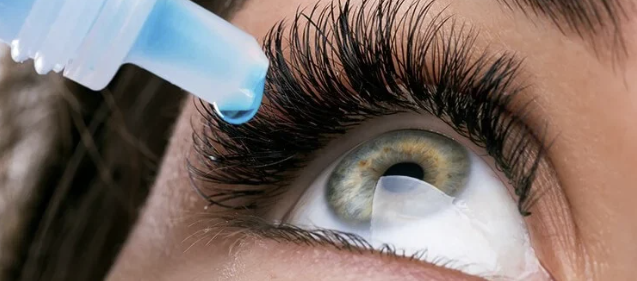
The process is quick. When we get to a certain point of the eye exam, we may instill drops—usually tropicamide 1% (sometimes cyclopentolate 1% if needed). After 15–30 minutes, the pupils enlarge, and we continue with the exam.
Tropicamide 1%
Effect: Dilation with mild cycloplegia
Onset: 15–30 minutes
Duration: Typically 2–3 hours, up to 6
Side effects: Light sensitivity, temporary blurred near vision
Cyclopentolate 1%
Effect: Stronger cycloplegia and dilation
Onset: 30–45 minutes
Duration: 12–24 hours or longer in younger children
Side effects: Longer near blur, mild systemic side effects in rare cases
To reduce systemic absorption, we perform punctal occlusion—a technique where we press on the inner corners of the eyelids for 1–2 minutes after applying drops. This is especially helpful in younger children.
When Should Dilation Be Avoided?
There are rare situations where dilation is contraindicated, such as:
Anatomically narrow angles (your doctor will check this first)
Known allergy or adverse reaction to dilation drops
Dr. Chow’s Perspective
As a functional optometrist, I believe in personalized, conservative care. I never want to over-medicate a child. Just like I never want to prescribe a prescription that is stronger than what the child needs. But at the same time, I also don’t want to miss something that could affect their visual development. That’s the balance we aim for.
While some providers rely heavily on dilation and cycloplegia for every prescription, I rely on my retinoscopy and functional testing. We use techniques like near retinoscopy, accommodative amplitude, and facility testing that help us gauge focusing skills without drops. But still, in certain situations—like strabismus, suspected hyperopia, or accommodative spasm—pharmacological cycloplegia gives us the clarity we need.
Dilated fundus exam can reveal serious conditions that aren’t visible through an undilated pupil, including:
Retinal tears, detachments, or holes
Diabetic or hypertensive retinopathy
Optic nerve swelling or atrophy
Macular degeneration or edema
Tumors, lesions, or chorioretinal scars
Inflammatory or infectious diseases
Why It Matters
A child might see 20/20 and still struggle in school, have headaches, or avoid reading. These issues are often missed when exams focus only on visual acuity. Dilation isn’t about checking a box—it’s about protecting vision and catching what’s otherwise invisible.
Whether you’re a parent with a nervous 6-year-old or an adult unsure if your blurry near vision needs more attention, understanding the why behind dilation can make the decision feel more comfortable.
Here’s what we recommend:
Talk to your doctor: Ask if dilation is necessary and why. If your child is being seen for routine care and shows no symptoms, it may not be needed.
Ask about alternatives: A skilled pediatric/functional optometrist can often gather a full picture without dilation, depending on the case.
Decide what’s right for your child: There’s no one-size-fits-all. Some children tolerate dilation well, others don’t. Your comfort matters too.
Trust your provider: Find an optometrist who explains their reasoning and respects your role in the decision.
At Miami Vision Therapy, we provide comprehensive exams—with or without dilation—and we tailor our approach to each patient. Dilation is a valuable tool, but it’s not always required.

All Vision Therapy Services
Discover personalized eye care excellence with our comprehensive vision therapy services. Our expert team treats a wide range of vision conditions, including amblyopia (lazy eye), strabismus (eye misalignment), binocular vision disorders, double vision, post-concussion vision syndrome, and more.

Keep In Touch
For non-urgent questions or to learn more about our services, contact us today!
© 2026 Miami Vision Therapy. All rights Reserved -
Accessibility Statement
-
Privacy Policy
-
Sitemap
Managed and Designed by 