Can Light Calm the Nervous System? What Syntonics Does That Glasses Can't
August 2026
Dr. Eric Chow, OD
How filtered light reaches the part of the brain that controls stress, focus, and the way your eyes work together
MIAMI — A thirteen-year-old girl arrives at Miami Vision Therapy holding her head at a slight angle, the way people do when they've quietly learned to manage double vision. She had been referred by an ophthalmologist. The workup had been thorough — including an MRI, which came back completely normal. There was no concussion, no injury, no obvious explanation. But every time she looked down at her homework, the page split into two overlapping images, tilted diagonally against each other.
She was already under care for nearsightedness, on a well-established myopia control program. Her prescription was being managed carefully. And still, something wasn't right.
"Her eyes were healthy. Her scans were clean. Her glasses were correct," says Dr. Eric Chow of Miami Vision Therapy. "None of that told us why her two eyes had stopped working as a team."
The main point: Vision isn't only about clarity — it's about how the eyes coordinate, and coordination is governed by the nervous system. When a patient's autonomic nervous system is stuck in a heightened, stressed state, the eyes often show it first. Syntonics, a treatment that uses specific frequencies of filtered light, is one of the few tools that speaks directly to that system.
What syntonics actually is
Syntonic phototherapy, usually shortened to syntonics, is a treatment in which a patient looks into a low-intensity light of a specific color for a set period of time, in a series of sessions. There's no laser, no ultraviolet light, no drug, and nothing touching the eye. The patient sits comfortably and looks into a soft, filtered light.
The word "syntonic" comes from the idea of bringing something back into balance. That's the entire premise: certain frequencies of light appear to nudge an over-activated nervous system toward calm, and an under-responsive one toward alertness.
"When I first describe it, patients sometimes assume it must be new and experimental," Dr. Chow says. "It's actually one of the older treatments in our field — optometrists have been using it since the 1920s. What's new is how much better we now understand why it works."
The part most people miss: light doesn't only go to the visual cortex
Here's the piece that reframes everything.
Most people assume that light entering the eye travels to the back of the brain, where it's turned into an image. That's true — but it's only part of the story. A meaningful share of the signal branches off along the way and never becomes a picture at all.
Some of those fibers land in the hypothalamus, the brain's master regulator for sleep, hormones, body temperature, appetite, and stress. Others feed structures in the brainstem that govern reflexes, arousal, and the pupil. These are the control rooms of the autonomic nervous system — the automatic system running your body in the background, split into two branches:
The sympathetic branch is the accelerator: fight-or-flight, heightened alertness, pupils dilating, the body braced for something.
The parasympathetic branch is the brake: rest-and-digest, recovery, repair, the settled state in which the eyes can comfortably converge and focus on something close.
Reading, homework, and screen work are fundamentally parasympathetic tasks. They require your eyes to turn inward and focus at near — which only happens comfortably when the body feels safe enough to settle.
"If a patient's system is stuck in accelerator mode, asking their eyes to team up at near is like asking someone to fall asleep during a fire drill," Dr. Chow explains. "You can prescribe all the right lenses and they still won't be able to do it."
Because light reaches these regulatory centers directly, it becomes a way in. Not a metaphor — an actual anatomical pathway from the eye to the systems that set your body's baseline state.
The pupil tells on you
There's a simple, objective way to see this imbalance in the exam room.
Shine a steady light into a healthy eye and the pupil constricts — and then holds. It should stay constricted for roughly ten seconds while the light remains on. That sustained hold is parasympathetic work.
In many struggling patients, the pupil constricts and then quietly begins to re-open while the light is still shining. Clinicians call this pupillary escape. It suggests sympathetic tone is overriding the calm response — a nervous system that can't stay settled even for ten seconds.
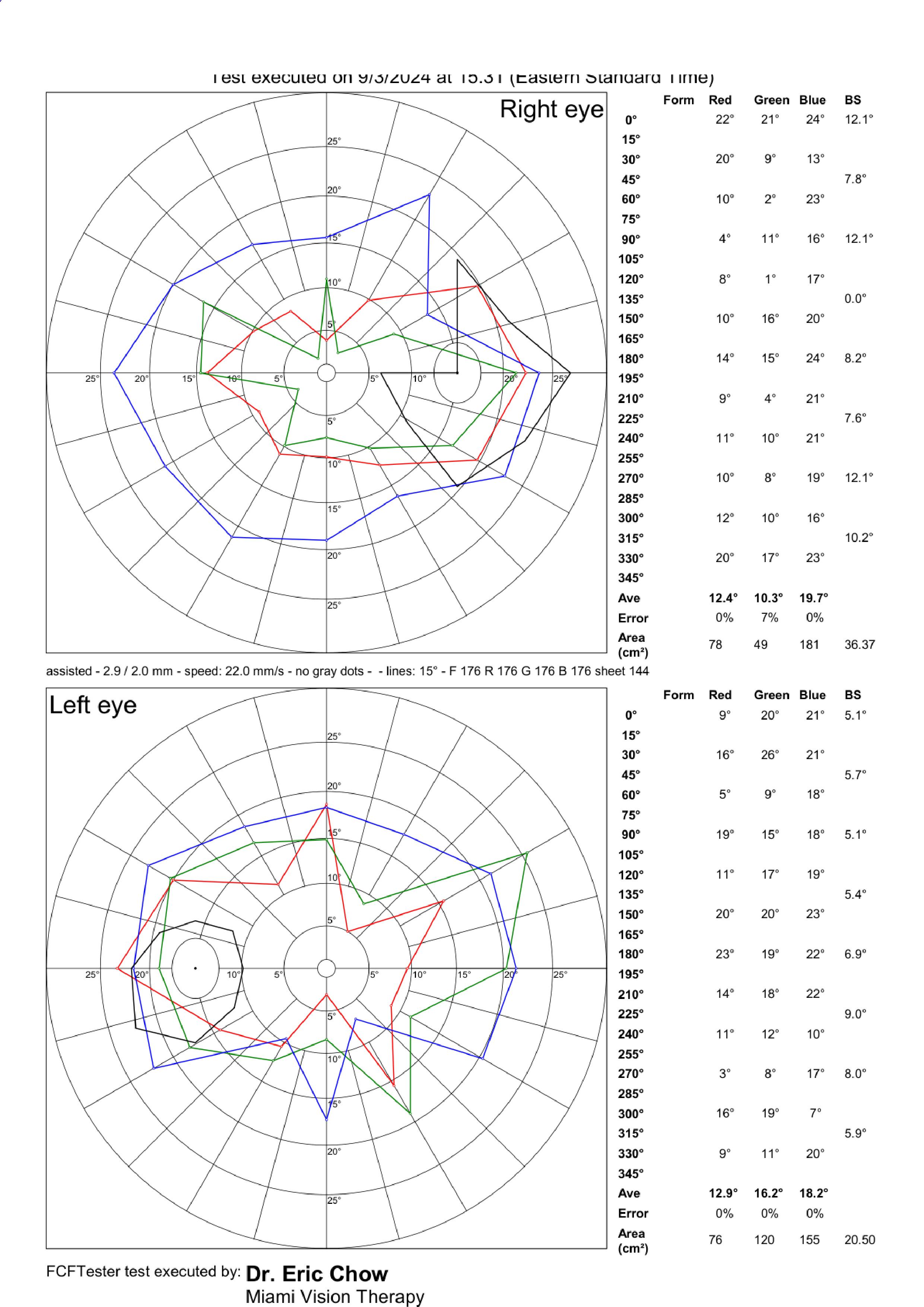
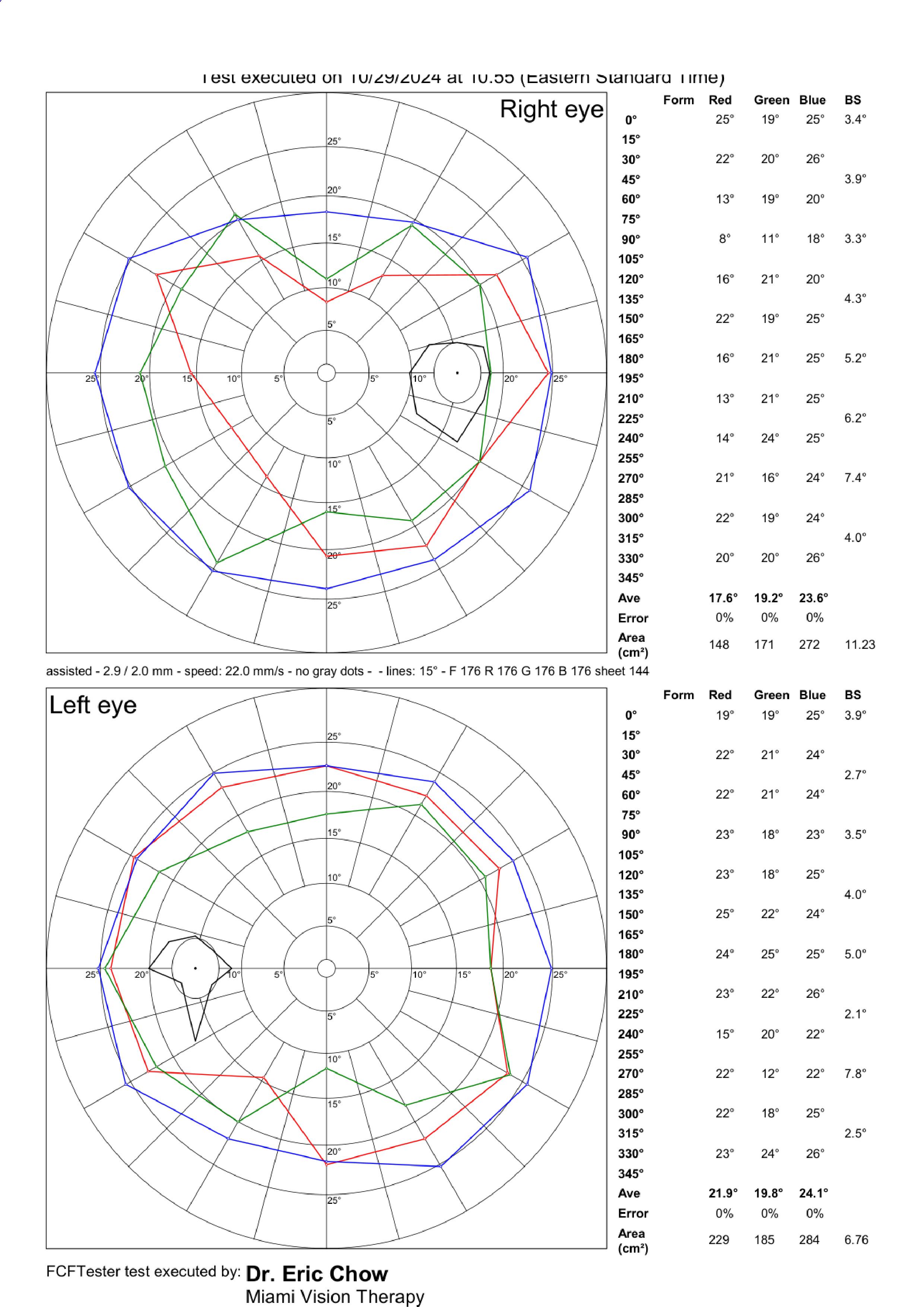
Another window is the functional visual field. Using a standard testing setup, a clinician can map how far out into the periphery a patient reliably notices a target. Patients under sustained nervous-system stress frequently show a constricted field — their usable awareness of the world has narrowed. Comparing that map before and after a course of syntonics is often the most striking part of the process for families, because the change is visible on paper rather than a matter of opinion.
Back to the thirteen-year-old
The full examination told a very different story than "she needs a stronger prescription."
Her eyes drifted outward at near — up to a substantial amount when measured — an alternating exotropia at near, meaning either eye could be the one that wandered. She had convergence insufficiency: her eyes struggled to turn inward together for close work. Her focusing system lagged behind where it should have been. She had no stereopsis, meaning she wasn't fusing the two images into a single three-dimensional picture at all. And her brain had begun to suppress — shutting off input from one eye some of the time to avoid the double image, a workaround that solves the symptom and deepens the problem.
She completed a full course of vision therapy, and it helped. But the piece Dr. Chow believes moved the needle most was syntonics.
"Her line to me at the end is the one I still repeat," he says. "She told me, 'My eyes feel happier.' That's a thirteen-year-old describing what it feels like when your nervous system finally lets go of the brakes."
Two things every parent should take from this case
First: myopia control strategies can have binocular vision consequences. Slowing the progression of nearsightedness in children is genuinely important work, and the tools available today — specialty contact lenses, atropine drops, specialty spectacle lenses — are a real advance. But they change how light focuses inside the eye, which changes the demands on focusing and eye teaming. That doesn't make them wrong. It means a child on a myopia control program deserves periodic checks of how their eyes work together, not just how fast their prescription is changing. Nobody should discover a problem the way this family did.
Second: myopia and eye teaming problems can both be downstream of the same thing. When a child's system is running hot — chronic stress, poor sleep, relentless near work, a nervous system that never fully downshifts — that state has consequences for the eyes. Treating the refractive number alone treats the readout, not the machine.
A wider shift toward light and the injured brain
Interest in this kind of intervention isn't confined to functional optometry. Researchers at the University of Miami are currently recruiting for a study of a light- and motion-based therapy for adults with lingering symptoms after mild traumatic brain injury — a protocol that delivers low-intensity filtered light alongside coordinated vestibular and auditory input, with dizziness as the primary outcome being measured.
That study is not syntonics, and its results aren't in yet. But it reflects a broader recognition that carefully controlled sensory input — light very much included — may be a legitimate way to help a dysregulated nervous system find its footing again. It's a question worth asking properly, and it's being asked here in Miami.
Who syntonics tends to help
At Miami Vision Therapy, syntonics is offered in office and is used most often for patients whose symptoms don't line up with what a standard eye exam finds:
Children with convergence insufficiency, focusing problems, or a constricted functional visual field. Patients recovering from concussion who remain light-sensitive, dizzy, or foggy long after their scans came back clean. Children and adults with reading fatigue, headaches after near work, or that unmistakable pattern of a system that fatigues as the day goes on. It's rarely used alone — it usually accompanies vision therapy, giving the nervous system a way to settle so the therapy can take hold.
Key takeaways:
Syntonics uses specific frequencies of low-intensity filtered light to help rebalance the autonomic nervous system. It is non-invasive, drug-free, and has been used in optometry since the 1920s.
Light entering the eye doesn't only produce images — some of it travels to the hypothalamus and brainstem, the control centers for stress, sleep, arousal, and the pupil.
Comfortable near work is a parasympathetic activity. A nervous system stuck in fight-or-flight makes eye teaming and focusing genuinely difficult, no matter how accurate the prescription.
Objective measures — how long a pupil holds under steady light, and how wide a patient's functional visual field maps — let clinicians see this imbalance and track whether it's improving.
Myopia control strategies can carry binocular vision consequences, and both myopia and eye teaming problems can be symptoms of an underlying autonomic imbalance.
If your child has been told their eyes are healthy but reading is still a fight, or if you're months out from a concussion and still not yourself, the missing piece may not be a stronger prescription. It may be a nervous system that needs help finding its way back to balance.
Miami Vision Therapy offers syntonic phototherapy in office as part of comprehensive functional vision care. To schedule a functional vision evaluation with Dr. Eric Chow, contact the practice.

All Vision Therapy Services
Discover personalized eye care excellence with our comprehensive vision therapy services. Our expert team treats a wide range of vision conditions, including amblyopia (lazy eye), strabismus (eye misalignment), binocular vision disorders, double vision, post-concussion vision syndrome, and more.

Keep In Touch
For non-urgent questions or to learn more about our services, contact us today!
© 2026 Miami Vision Therapy. All rights Reserved -
Accessibility Statement
-
Privacy Policy
-
Sitemap
Managed and Designed by 